AI on the Cheap: Getting Frontier-Level Results on a Budget
How I ship real projects with open-weight models and a $10/month subscription
In this AI world, you hear about people having multiple agents running 24/7 doing all the things and Claude this and GPT that, and you go… "how many tokens is that?" What kind of subscription do they have that allows them to do all that? Are they paying the API token cost?
A thought that often comes to mind is "I'd love to do that, but it's too expensive!" Even if doing it is not technically difficult (with AI, many things that sound technically difficult are actually not), it would end up costing a ton. When doing personal projects, that's the boat I'm in. Don't want to spend a ton of money on things that are not super important, although I'd like to do them. For example, I wanted to spin up a few agents to handle the repetitive parts of building my side SaaS tool, but the token math made it feel out of reach.
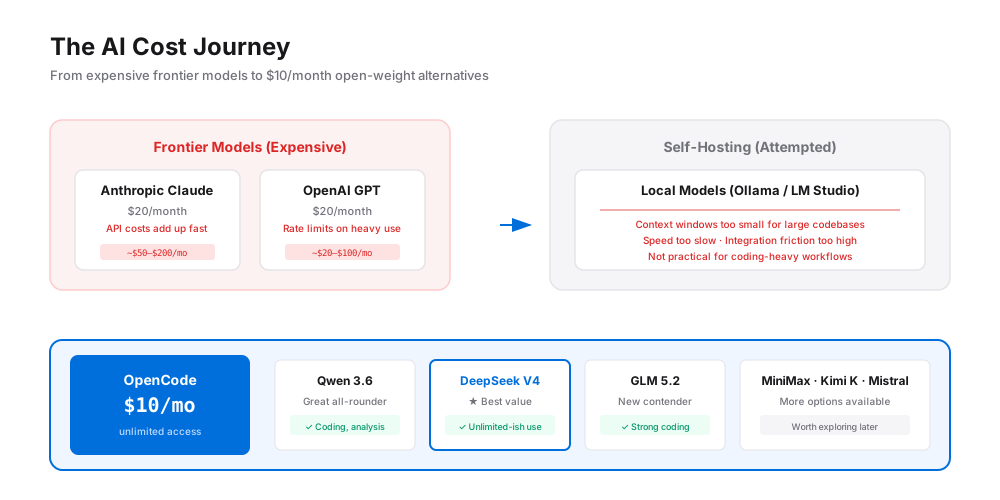
That took me on the journey of nickel and diming AI costs. Tried two main things: cheaper models and self hosting.
The Cost Barrier
Self hosting is nice and goes a long way if you're not doing technical work (i.e., coding), but a lot of what I do is coding, so I stopped using local models early on. Speed was slower, context windows felt limited for larger codebases, and integrating them into my normal workflow was more friction than I wanted. Was ok with spending a bit of money to get something better and faster.
Finding OpenCode
That's when I bumped into OpenCode. They give you access to non-frontier models (Qwen, DeepSeek, GLM, Mistral, etc.) and a $10/month subscription with generous limits. This opened the door for all the projects I want to do, basically for 10 bucks a month.
Testing the Models
I've been trying the different models and it's amazing the work they crank out. With all the talk about them being politically censored in some areas, that doesn't seem to matter when coding.
At the time I'm writing this, Qwen 3.7 and GLM 5.2 just came out. Sonnet 5 is about to come out as well, which will lower the cost of Claude use, so the equation may change a bit.
My thoughts / experience: Qwen 3.6 does pretty much everything you need. Qwen 3.7 seems to consume a lot more tokens, but it's directed at longer running tasks, so if you have some short tasks (e.g., produce a chunk of code), then 3.6 works just fine. That said, Qwen is still more expensive than the cheapest of the cheap: DeepSeek. So I hit the $10 OpenCode subscription limit using Qwen 3.6 and switched to DeepSeek V4 (using medium context most times).
DeepSeek V4: The Unlimited AI
Using DeepSeek V4, you have basically unlimited use of AI. It's amazing. Question is: is it any good? Answer: yes, it's very good.
Initially, I was keeping a close eye on the code produced by DeepSeek and as I gained confidence, gave it harder tasks. So far, been working like a champ. Working on a SaaS tool (Python backend, TypeScript/React frontend) and it handles everything no problem. For instance, it built a clean FastAPI endpoint for user authentication with proper error handling, and later fixed a tricky state management bug in the React frontend that had me stuck for an afternoon. It does occasionally need a bit more prompting or a quick review on edge cases, but nothing that slows me down much.
What About the Others?
Haven't used other open weight models too much (GLM, MiniMax, Kimi K, etc.), mostly because I'm happy with DeepSeek and haven't had a need to look elsewhere. I'm sure that will change: frontier models become cheaper (Sonnet 5) and open weight models become more expensive (GLM 5.2), so keeping a close eye on the evolution.
The real win here is using these cheaper models as a solid foundation while I stay in the loop for the final human touch — refining the narrative, adding real context, and making sure the output actually fits what I want to share. It lets me produce more without losing the personal edge that actually matters.
What cheaper or open-source setups have you tried for your own projects? I'd love to hear what's working for you.
Takeaway: You can get frontier-level results on a budget by pairing the right open-weight models with light oversight. The savings let you focus on the parts only you can do. Keep an eye on the releases and adjust as the landscape shifts.